


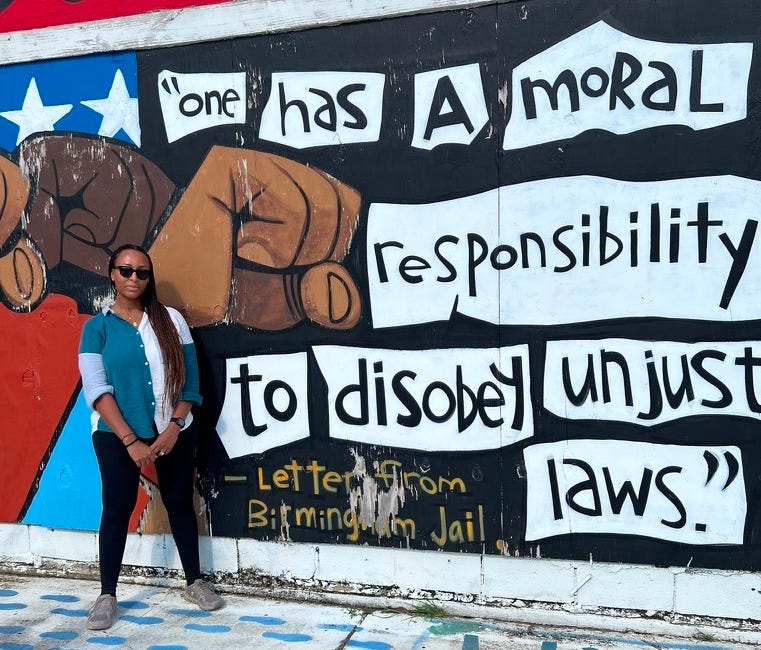
I’ll never forget when I was a 24 year old publicist at a work dinner with my then boss (aka the owner of the travel PR agency I worked for), and she asked me about my upcoming plans for the Christmas holiday.
Me: “Oh, my family and I will be driving down to Louisiana. We spend every Christmas there.”
Her: (gasp) “Really? Wow. I’ve never been to the South. I don’t think I could ever go, I’m too scared.”
Me: stares in wine drunk confusion “What are you scared of? You’re white.”
slowly blinking at each other in shock.
If I had a dollar for all the people who’ve told me they’d never travel to a red state, I’d have a nice little bundle. I find the blanket statement to be so annoying. While I do believe that travel is political and you shouldn’t spend your money supporting people, companies and local governments that don’t share your morals and values, writing off an entire state (or in my former boss’s case, an entire region) due to its election results low key makes you as prejudice as the folks you claim to not be like…except when it comes to Florida lol. But I digress.
Thanks to my upbringing, I’ve always been able to look at the Deep South with more nuance. First of all, let’s be for real: racist policies and racist people are all across the United States. In fact, the first time I was called the n-word was by someone from New Hampshire, and the second time, a group of men in Boston screamed it at my friends and I from their car while we walked down the street minding our business. Gotta love that drive-by racism! I’ve found that many of these so-called blue states up north are filled with people that are weirdly obsessed with the antebellum-era south, confederate flags and all. I’m not sure why they seem to believe that the South is their ideal, all-white haven, but I can only imagine it’s because they’ve never set foot past the Mason-Dixon line.
When I decided to road trip with my Mom from DC to Alabama, then throughout the state this September, many folks I knew were flabbergasted. Why would two Black women want to not only drive to Alabama on their own, but then spend more time in the state exploring other major cities and small towns? My first thought was, why wouldn’t we? I know that having parents from both Louisiana and Alabama, and visiting both states regularly while growing up, has drastically altered my views on the South and perhaps even the entire United States. I believe deeply in my core that there is not a single place in this land that Black Americans should not go/cannot go because we’ve always been here, but at the same time I’m a realist. There are absolutely locations in the U.S. that are not only not safe for Black Americans, but probably wouldn’t even interest most of us in the first place. However, the Deep South is not one of them.
Alabama is a state that I believe all Americans need to visit if they want to have a full understanding of the American story. Full stop. Montgomery. Birmingham. Selma. Tuskegee. Gee’s Bend. These are not just must-experience places for Black travelers, and frankly I don’t think that Black travelers have an aversion to visiting them. However, if you do, I get it. But I want to remind you of something: an incredible amount of Black joy also exists in the Deep South. Contrary to what some of those weirdos up north may think, the South is still home to huge populations of Black folks that have chosen to stay, build businesses, and raise families, and do you really think they’d stay if they were absolutely miserable? I doubt it.
Every time I go down South it feels like a homecoming and I don’t think it’s just because my parents are from there. I think it’s because wherever Black Americans find one another in our travels, we feel a kinship. That combined with the fact that the culture of the South is to chit chat upon making eye contact means that I found myself in constant conversation and laughter with strangers who became friends. When you go to some of these hard to digest places like the Legacy Sites in Montgomery, 16th Street Baptist Church in Birmingham or Foot Soldiers Park in Selma and it starts to feel like too much, all you have to do is make eye contact with a Black employee or resident to know that they immediately understand how you are feeling. But at the same time, in my experience, they are ready with a story to share about how their uncle, aunt, cousin or grandparents fought the good fight and they are proud of their family legacy. They are proud to be an Alabamian, to have stayed in their home state and to still be fighting to create a better America for us all.
Which brings me to the Mississippi election. When you think about it, I don’t think there’s group of people besides Black folks in the Deep South who understand how fragile our civil rights, especially our voting rights really are. What they’ve witnessed and experienced are levels of violence and corruption that the rest of us can hardly conceptualize, and now these same people were watching the rights their family members literally died for be snatched away by their local politicians after being emboldened by this administration. Clearly the Black South had something to say about that. They showed up and showed out.
During a guided tour of Selma with Ms. Barbara Barge, who was 15 years old at the high of the voting rights crack down in Selma, she urged us to understand that the Civil Rights Movement was not a moment in time and that the belief that it ended sometime around 1969 is how the Civil Rights Act of 1964 was gutted in April 2026. She knows first hand that rights will never be offered to Black Americans out of the goodness of anyone’s heart. They will constantly have to be fought for and protected. She also urged that voting is literally the bare minimum we can do. We have to show up at the polls, sign up to be poll workers, knock on doors, help register voters, turn the entire experience into a community uplift. Before the tour ended I had already signed up to be a poll worker in Virginia.
And this is what I love so much about Alabama and the greater South. While you can go there to experience history, the unfortunate/fortunate part is that what happened in Alabama and across the South is still so relevant to what is happening today. Thankfully the blueprint to defeat it already exists. When I go to the South, history doesn’t feel like something I view behind a glass partition. It feels alive and like something I can take part in right now. And while I know not everyone wants to or should go on vacation and then leave feeling drained and like they immediately need to get to work, I found it to be incredibly inspiring BUT I also don’t think this work should solely be on us.
What I’ve seen in my travels and just in my regular life is that many white travelers don’t want to learn about their own history in these places. They don’t want to know and absorb the cruelty and violence that their ancestors were capable of, but if they don’t, they will never know a key part of themselves. Many of them think that these sites are “Black history sites” and therefore have nothing to do with them, but oh sweet baby girl, don’t kid yourself.
A strong argument can be made that what you will learn about enslavement, racism, Jim Crow, and violence in Alabama is more white history than Black history. The only part of that story (which spans hundreds of years and not just the Civil Rights Movement) that is Black history is the fact that we were able to survive and thrive through it. If you happen to be a white person reading this newsletter, especially if you’ve branded yourself as a liberal, I challenge you to spend time in the Deep South and learn about your history so you won’t be doomed to repeat it and won’t stay silent when you see your peers abusing the civil rights of others.
While I was flooded with the hard histories of places like Selma, Montgomery and Birmingham, I couldn’t help but think about how the hell we got from there to where we are today. And I think the culprit may actually be the same villain. All of the people who decided to look away when they saw heinous things happening to their Black brothers and sisters but decided that since they weren’t actively participating in it, they weren’t culpable. They were wrong. And if that’s you today, you’re wrong as well.
This newsletter has taken a hard left into a topic I wasn’t planning to talk about so I’m going to try to bring it back to travel. As you can see, my journey through Alabama radicalized me. To my Black readers/travelers: if there is ever a time that you feel unsure of yourself or that you don’t have the confidence to do something or become who you’ve dreamed of being, go to the Deep South. Put your hands in the dirt, visit the Legacy Museum, walk the campus of Tuskegee Institute, visit Moton Field where the Tuskegee Airmen learned to fly, walk across the Bloody Sunday bridge in Selma (I’m refusing to write the actual name because it’s named after a Klan grand wizard or whatever the hell they’re called). What you learn there and the people you will meet will fortify you. You will realize that the blood running through your veins cannot be stopped no matter what forces are against you because the only way our ancestors survived was thanks to a God that continues to protect us.
I know many of you subscribe to this newsletter for ideas of where to go and what to do in your travels and this newsletter may not have hit that mark. However, if you’ve made it this far, thank you. And I promise the next newsletter (which will come in days, not weeks) will have a full rundown of our Alabama itinerary.
Much love as always,
S